Outdoor Christmas Lights Safety: Strands, Ladders and Timers
How to hang outdoor Christmas lights safely: connection limits, circuit wattage math, outdoor cords and GFCIs, ladder rules and timers, with a season checklist.
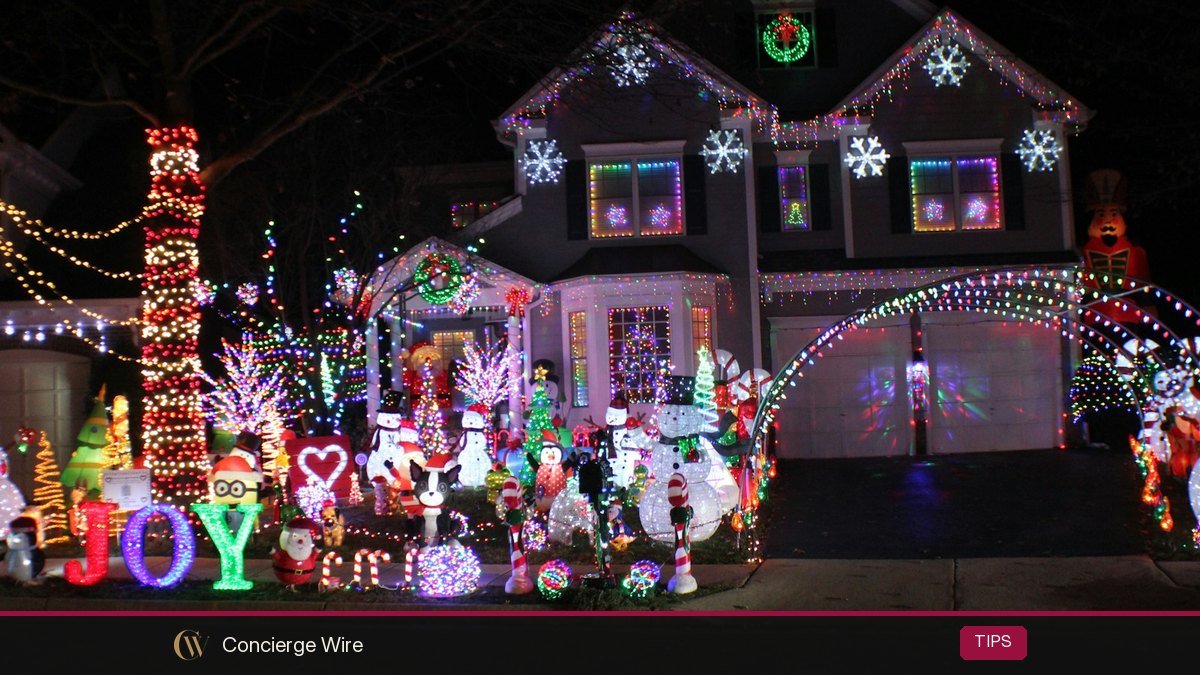
Outdoor Christmas lights are safe when you use outdoor-rated sets, plug them into a GFCI-protected outlet, follow the connection limit printed on the box, and keep your ladder steady and well away from power lines. This guide gives you the quick rules, the math for how many strands one outlet can take, ladder and timer tips, and a pre-season checklist, all checked against CPSC, OSHA and NFPA guidance.
Updated October 2026.
Key Takeaways
- The U.S. Consumer Product Safety Commission (CPSC) says never string together more than three sets of incandescent lights. For LED sets, follow the maximum printed on the package or tag.
- A standard 15-amp household circuit supplies about 1,800 watts; plan to use no more than about 1,440 watts (80%) for lights that stay on for hours.
- Use only lights and extension cords marked for outdoor use, and plug into a GFCI outlet.
- Falls are the most common cause of holiday decorating injuries. Set your extension ladder at a 4-to-1 angle, extend it 3 feet above the roofline and never stand on the top step of a stepladder.
- Put your display on an outdoor-rated timer so lights are off overnight and when nobody is home.
Quick Answer: The 10 Rules for Outdoor Holiday Lights
| Rule | Why it matters |
|---|---|
| Use lights labeled for outdoor use | Indoor sets are not built to handle rain, snow and cold. |
| Look for a testing-lab mark (UL, ETL or CSA) | Shows the product was tested to a safety standard by a recognized lab. |
| Max three incandescent sets end to end (CPSC) | More sets can overheat the first set’s wiring. |
| Follow the LED set’s printed connection limit | LED limits vary by product; the tag is the rule. |
| Plug into a GFCI outlet | Cuts power fast if current leaks to ground, such as through water. |
| Use outdoor-rated extension cords | Indoor cords crack in the cold and are not made for wet ground. |
| Keep connections off the ground | Prevents plugs sitting in puddles or snowmelt. |
| Use plastic clips, not nails or staples | Metal fasteners can cut insulation and energize gutters. |
| Ladder: 4-to-1 angle, 3 feet above the edge | Prevents the most common decorating injury: falls. |
| Use a timer and turn lights off overnight | Less run time means less heat, less risk and a lower bill. |
Why This Matters: What the Safety Data Shows
Holiday decorating sends thousands of Americans to the emergency room each season. CPSC estimates from recent years have ranged from roughly 14,000 to more than 18,000 emergency department visits per season for decorating-related injuries, and falls have consistently been the leading type. Cuts, back strains and electrical shocks follow.
Fire is the other risk. The National Fire Protection Association (NFPA) has reported that U.S. fire departments responded to an average of about 150 home fires a year that started with Christmas trees in 2017 to 2021, and that electrical distribution or lighting equipment, which includes decorative lights, was involved in more than two of every five of them. NFPA’s winter holiday safety page collects its current tips and figures. Outdoor displays add water, cold and long cord runs to the mix, so the rules below matter more outside than in.
Choosing Safe Outdoor Lights
Check the label before you buy
Every light set and cord sold through reputable stores should carry the mark of a Nationally Recognized Testing Laboratory, most often UL, ETL (Intertek) or CSA. The package should also say clearly whether the set is for indoor use only or for indoor and outdoor use. On UL-listed sets, a green holographic UL mark indicates indoor use, while a red one indicates indoor and outdoor use. If the box does not say outdoor, it stays inside.
Be careful with very cheap sets from unknown online sellers. Counterfeit safety marks exist. Buy from retailers you trust and check the CPSC recall list if a product seems questionable.
LED vs incandescent
LED sets draw a fraction of the power of incandescent sets, run much cooler to the touch, and usually allow far more sets to be connected end to end. That makes them the easier, safer choice for big outdoor displays. If you still have older incandescent strands, they can be used safely, but you have to respect the three-set limit and watch the wattage.
Inspect last year’s lights
Before anything goes on the house, lay each set out on a dry floor, plug it in and check it. Throw away any set with cracked or frayed wires, broken or empty sockets, loose connections, or plugs that are scorched or bent. The CPSC’s holiday safety center gives the same advice: replace damaged sets rather than patching them with tape.
How Many Strands Can You Plug Into One Outlet?
There are two separate limits, and people mix them up.
- The connection limit is how many sets you can plug end to end into each other. For incandescent sets, the CPSC says no more than three. For LED sets, it is the number printed on the tag or box, often stated in watts or as a number of sets.
- The circuit limit is how much total power all your lights, plus anything else on that circuit, can draw. This is set by the breaker.
The circuit math
Watts equal volts times amps. A typical U.S. household circuit runs at 120 volts.
- 15-amp circuit: 120 x 15 = 1,800 watts maximum. Plan for no more than about 1,440 watts (80%) for lights left on for hours.
- 20-amp circuit: 120 x 20 = 2,400 watts maximum. Plan for no more than about 1,920 watts.
Remember that one circuit often feeds several outlets, including indoor ones. If the garage freezer and the porch outlet share a breaker, the freezer counts against your budget.
Typical wattage by light type
These are typical figures for common sets. Always use the wattage printed on your own sets, which can differ.
| Light set (typical) | Approx. watts per set | Sets within a 1,440 W budget |
|---|---|---|
| 100-count incandescent mini lights | About 40 W | Up to 36 by wattage, but only 3 per run (CPSC) |
| 25-bulb C9 incandescent (7 W bulbs) | About 175 W | About 8 by wattage; check the box connection limit |
| 100-count LED mini lights | About 5 to 7 W | Hundreds by wattage; the box connection limit controls |
| 25-bulb LED C9 | About 2 to 5 W | Hundreds by wattage; the box connection limit controls |
| Inflatable yard decoration | About 60 to 150 W | Count each one against the budget |
Worked example (illustrative): A homeowner has a 15-amp porch circuit with nothing else on it. She runs four groups of three incandescent mini sets (12 sets x 40 W = 480 W) and two inflatables at 120 W each (240 W). Total: 720 W, well under the 1,440 W budget. Each group of three plugs separately into an outdoor power stake or multi-outlet cord rated for outdoor use, so no run exceeds three sets.
If a breaker trips or a GFCI keeps cutting out, do not just reset it and walk away. A tripping breaker means overload; a tripping GFCI often means moisture in a connection. Find the cause first.
Extension Cords, GFCIs and Connections
- Outdoor-rated cords only. Look for a “W” in the cord’s jacket code (for example SJTW) and an outdoor-use marking. Match the cord’s gauge to the load; for long runs, a heavier cord (lower gauge number, like 12 or 14) is safer.
- GFCI protection. Outdoor outlets in modern homes are normally GFCI-protected. Press the test button: power should cut off; press reset to restore. If your outdoor outlet is not protected, use a portable outdoor GFCI adapter or have an electrician add one.
- Keep plugs dry and off the ground. Use weatherproof connection boxes or covers, and prop connections on a stake or brick.
- Do not run cords through doors or windows. Closing a door on a cord crushes the insulation. Use an outdoor outlet instead.
- Do not daisy-chain extension cords or power strips. Use one cord of the right length.
- Keep cords out of walkways and driveways, or cover them with a cord protector.
Ladder Safety: Where Most Injuries Happen
OSHA’s portable ladder standard for workers (29 CFR 1926.1053) is a solid benchmark for homeowners too. It calls for an extension ladder’s base to sit about one-quarter of the ladder’s working length away from the wall, for side rails to extend at least 3 feet above the landing you are climbing onto, and it bans standing on the top or top step of a stepladder.
Ladder checklist
- Set the angle with the 4-to-1 rule. For every 4 feet of height to the top support point, the base sits 1 foot out. A quick check: stand at the base with toes touching the rails and arms straight out; your palms should reach the rung in front of you.
- Extend 3 feet above the gutter if you need to step onto the roof.
- Firm, level footing. No ice, mud, or wet leaves. Use leveler feet on slopes rather than stacking bricks.
- Three points of contact. Two hands and a foot, or two feet and a hand, at all times. Carry lights in a pouch or hoist them up with a rope.
- Keep your belt buckle between the rails. Overreaching is how ladders tip. Climb down and move it.
- Stay well away from power lines. Keep yourself, the ladder and any pole at least 10 feet from overhead lines, including the service drop to your house. Use a fiberglass ladder near any electrical source; aluminum conducts.
- Have a spotter to hold the ladder and pass things up.
- Do not decorate in wind, rain, ice or after dark.
If a job requires working on a steep or icy roof, hire a professional installer. Many holiday-lighting companies will also take the lights down in January.
Hanging Lights Without Damaging the House
- Use plastic gutter clips and shingle tabs, not nails, screws or staples, which can pierce wire insulation.
- Never fasten lights to metal gutters with metal hooks.
- Do not pull or yank lights off the roof when taking them down; it damages sockets and shingles.
- Do not wrap lights tightly around tree branches that will grow, and remove lights from live trees after the season.
- Keep lights and cords away from dry leaves, straw and other combustibles.
Timers and smart plugs
A timer is one of the cheapest safety upgrades. Lights left on all night and all day run hotter, wear out faster and cost more. Use an outdoor-rated mechanical or digital timer, or a smart plug rated for outdoor use, and set the display to run from dusk to bedtime, for example 5 p.m. to 11 p.m.
Photocell timers that turn on at dusk and off after a set number of hours are convenient because they adjust as days get shorter and then longer again. Check the timer’s amp or watt rating; it must handle your full load. Turn everything off when you leave town.
Pre-Season and Daily Safety Checklist
Before you decorate
- Inspect every set; discard damaged ones.
- Confirm outdoor ratings on all lights, cords, stakes and timers.
- Test the GFCI outlet.
- Add up wattage per circuit.
- Check the ladder for loose rungs or bent rails.
- Check the weather forecast.
Through the season
- Walk the display once a week looking for loose clips, cords in water or damaged sockets.
- Feel plugs and connections after the lights have been on for an hour; warm is normal, hot is not.
- Reset any tripped GFCI only after you find the cause.
- Keep inflatables staked down so wind cannot drag them into cords.
When you take it down
- Unplug before removing anything.
- Wrap lights loosely around cardboard or a reel to prevent kinks.
- Store in a dry place away from rodents, which chew wires.
Frequently Asked Questions
Can I use indoor Christmas lights outside?
No. Indoor-only sets are not designed for moisture or cold. Use sets clearly labeled for outdoor use, and keep indoor lights indoors.
How many LED strands can I connect together?
Follow the maximum on the set’s tag or box. Many LED sets allow far more than three, but limits vary by product and manufacturer. Do not mix LED and incandescent sets in one run.
Is it safe to leave outdoor Christmas lights on overnight?
It is safer to turn them off. Fire safety groups advise turning decorative lights off when you go to bed or leave home. A timer makes this automatic.
Why does my GFCI keep tripping with Christmas lights?
Usually moisture in a plug or socket, a damaged set, or too many devices on the circuit. Unplug everything, dry and inspect the connections, and add sets back one at a time to find the culprit.
Do I need a special extension cord for outdoor lights?
Yes. Use cords marked for outdoor use (look for a “W” in the jacket code) with a gauge suited to the load and length.
What is the safest ladder for hanging lights?
A fiberglass extension or stepladder rated for your weight plus what you carry. Fiberglass does not conduct electricity the way aluminum does, which matters near outdoor wiring.
Before You Climb
Take ten minutes before the first ladder goes up: inspect your sets, add up the watts, test the GFCI and set the timer. Then decorate in daylight with a helper. The display will look the same to the neighbors, and you will be far less likely to join the emergency room statistics. Safety guidance can be updated each season, so check CPSC and NFPA for the latest advice.